Frozen Shoulder
We Give You The Best ! Services THat You Can Trust


We Give You The Best ! Services THat You Can Trust


A shoulder joint is a joint between Humerus and Scapula. The Shoulder joint is supported by ligaments and capsule. Frozen shoulder syndrome is a condition that involves scouring inflammation and tightening of the connective tissue around the joints of the Shoulder. which results in shoulder pain and significant loss of range of motion of the Shoulder. Frozen Shoulder syndrome is also called Asadhesive Capsule. There is difficulty while elevating the Arm and taking the hands behind the back. Frozen Shoulder syndrome affects people between 45 to 65 years of age. Frozen Shoulder more commonly affect women when compared to men.
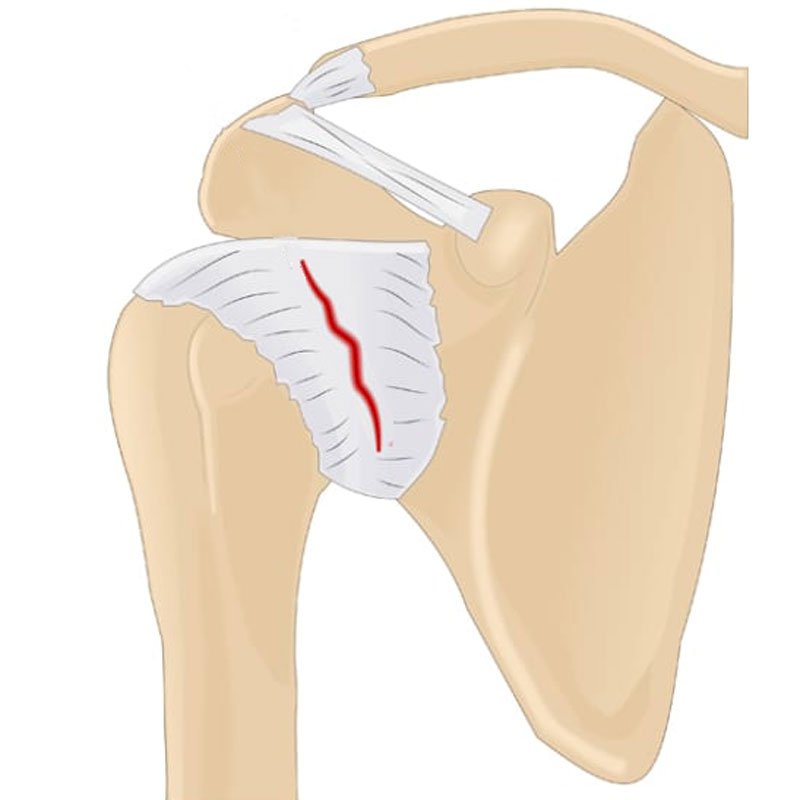
Shoulder becomes increasingly painful, and you slowly lose range of motion. This usually occurs over 6 to 9 weeks.
Treatment Time : 2 Month
Sesssion Required : 10
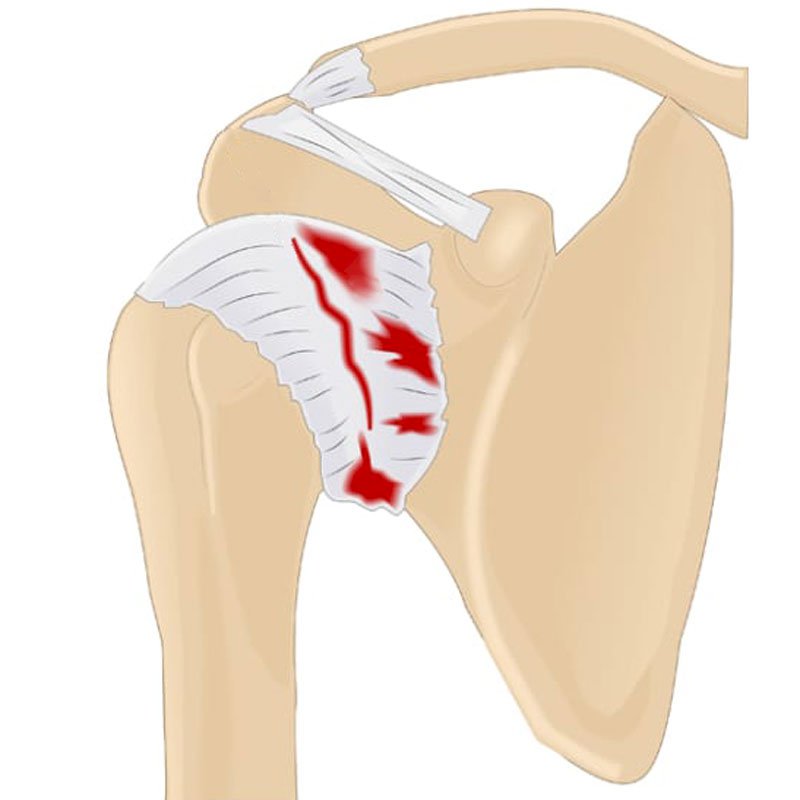
This stage immediately follows the freezing stage and is usually less painful though the stiffness remains. This usually lasts roughly 4 to 6 months making daily activities very difficult.
Treatment Time : 6 Month
Sesssion Required : 20
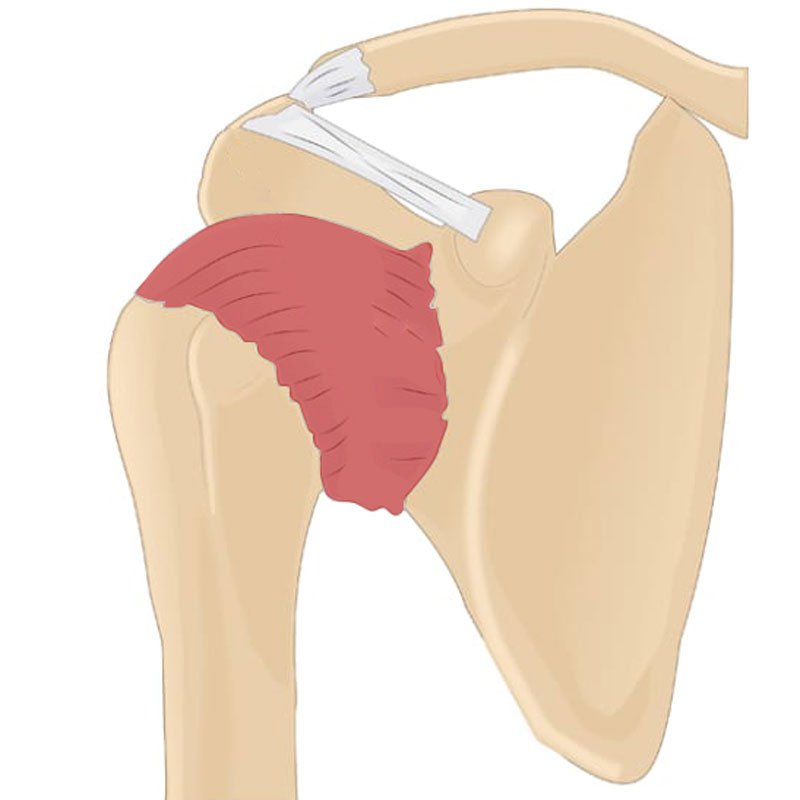
This stage is where the shoulder slowly improves with either a complete return to normal or close to normal strength and motion. This usually takes anywhere from 6 months to 2 years to happen.
Treatment Time : 9 Month
Sesssion Required : 45
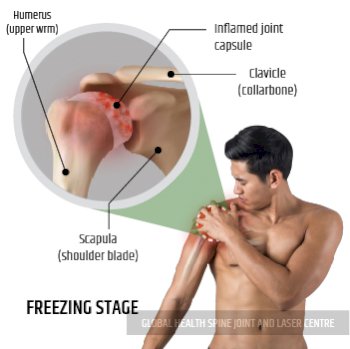
In this freezing Stage, the Shoulder becomes increasingly painful, and you slowly lose range of motion.

Laser Beam has been applied to fix the frozen shoulder.
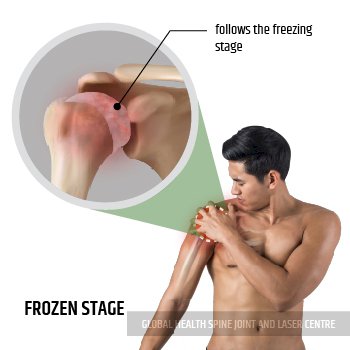
After laser treatment, it comes into Frozen Stage, This stage immediately follows the freezing stage and is usually less painful though the stiffness remains.

Then it comes to Thawing Stage. This stage is where the shoulder slowly improves with either a complete return to normal or close to normal strength and motion.

After some sittings, the shoulder is Healed, and in a full range of motion.

Step 1 : Using your good arm, lift the affected arm onto a table about breast-high.
Step 2 : Gently bend your knees, opening up the armpit. Deepen your knee bend slightly, gently stretching the armpit.
Step 3 : Then straighten the knee. With each knee bend, stretch a little further, but don’t force it.
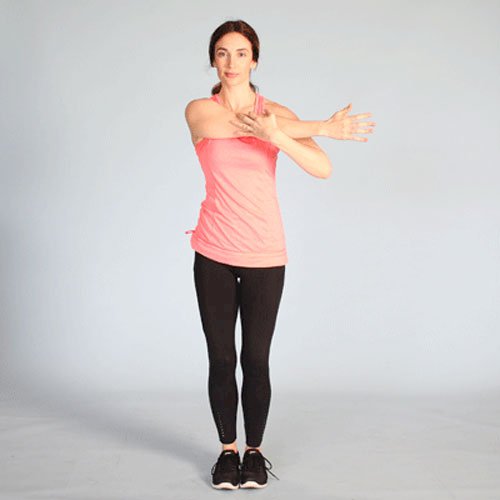
Step 1 : Sit or stand. Use your good arm to lift your affected arm at the elbow.
Step 2 : Bring it up and across your body, exerting gentle pressure to stretch the shoulder. Hold the stretch for 15 to 20 seconds. Do this 10 to 20 times per day.

Step 1 : Face a wall three-quarters of an arm’s length away. Reach out and touch the wall at waist level with the fingertips of the affected arm.
Step 2 : With your elbow slightly bent, slowly walk your fingers up the wall, spider-like, until you’ve raised your arm as far as you comfortably can. Your fingers should be doing the work, not your shoulder muscles. Slowly lower the arm and repeat. Perform this exercise 10 to 20 times a day.
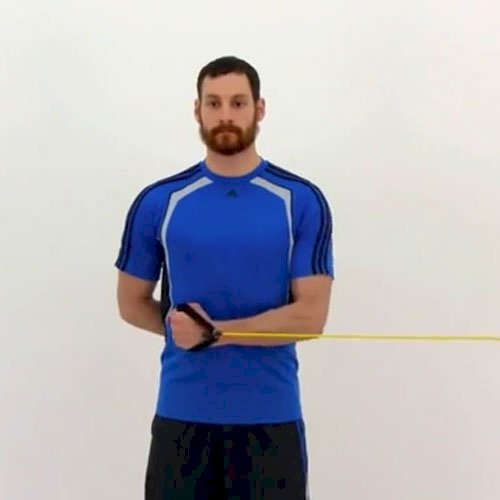
Step 1 : Stand next to a closed door, and hook one end of a rubber exercise band around the doorknob. Hold the other end with the hand of the affected arm, holding your elbow at a 90-degree angle.
Step 2 : Pull the band toward your body two or three inches and hold for five seconds. Repeat 10 to 15 times, once a day.

Step 1 : Hold a rubber exercise band between your hands with your elbows at a 90-degree angle close to your sides.
Step 2 : Rotate the lower part of the affected arm outward two or three inches and hold for five seconds. Repeat 10 to 15 times, once a day.

Step 1 : Stand beside a table with the hand of your unaffected shoulder on the table and feet slightly wider than shoulder-width apart. Bend at the hips approximately 75 to 90 degrees and let your affected arm hang down toward the floor.
Step 2 : Letting your arm swing freely side to side. Shift your weight forward and backward.
Step 3 : Letting your arm swing freely front to back.
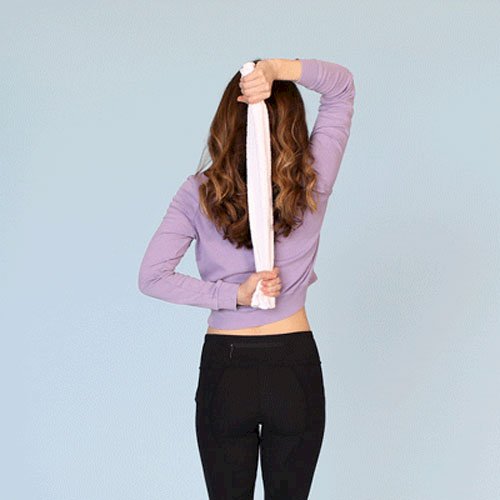
Step 1 : The towel shoulder internal rotation stretch is a great exercise to improve the way your shoulder or rotator cuff moves.
Step 2 : It can be an effective stretch for a frozen shoulder and as part of your post-op rotator cuff surgery protocol.

Contains

Contains

Contains

Contains

Contains

Contains