
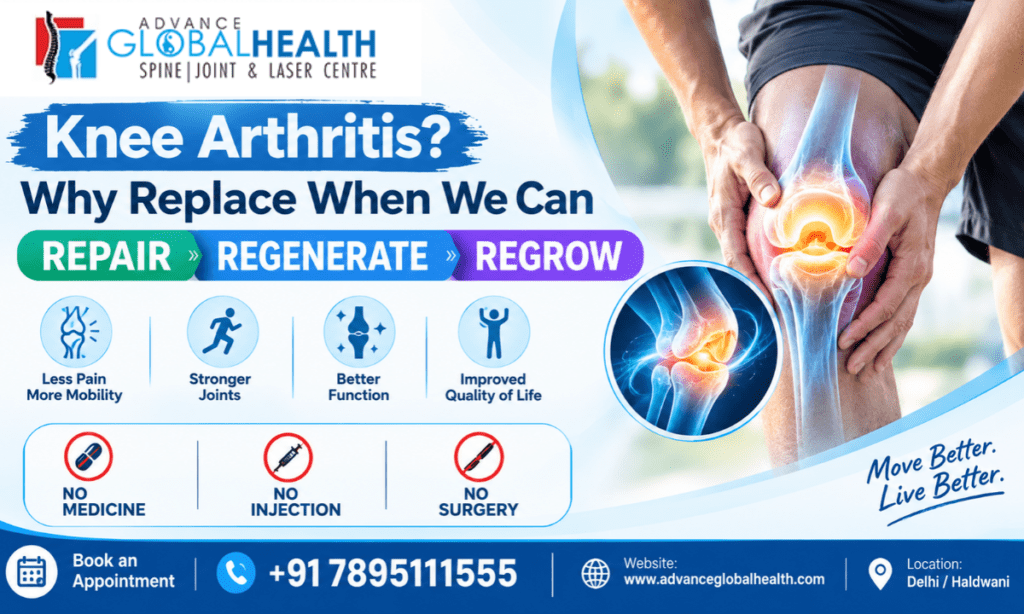
Knee pain is one of the most common problems affecting adults, especially as they grow older. For many people, persistent knee pain, stiffness, swelling, and difficulty walking may be caused by knee arthritis. When the pain becomes severe, patients often worry that knee replacement surgery is their only option.
But is that always true?
The answer depends on several factors, including the type and stage of arthritis, the severity of joint damage, symptoms, age, activity level, and overall health. In many cases, knee arthritis treatment without surgery may help manage pain, improve mobility, and support a better quality of life.
At Advance Global Health, we believe in a comprehensive and personalised approach to joint care. This blog explains the causes of knee arthritis and explores the possibilities of knee arthritis treatment without surgery and knee replacement treatment without surgery.
People Also Like to read this: Can AVN of the Hip Be Treated Without Surgery?
What Is Knee Arthritis?
Knee arthritis is a condition that causes inflammation and damage within the knee joint. The most common type is osteoarthritis, which occurs when the protective cartilage that cushions the bones gradually wears down.
As the condition progresses, the joint may become painful, stiff, and difficult to move.
Common symptoms of knee arthritis include:
- Persistent or recurring knee pain
- Stiffness, especially after rest
- Swelling around the knee
- Difficulty walking
- Pain while climbing stairs
- Reduced range of motion
- Clicking or grinding sensations
- Weakness around the knee joint
The severity of symptoms can vary significantly from person to person.
Can Knee Arthritis Be Treated Without Knee Replacement?
Yes, in many cases, patients may explore knee arthritis treatment without surgery, particularly when the condition is diagnosed and managed appropriately.
However, it is important to understand that not every patient with knee arthritis will have the same treatment needs. Some patients may have mild symptoms and early joint changes, while others may have advanced arthritis and significant structural damage.
Non-surgical treatment may focus on:
- Reducing pain
- Improving joint mobility
- Strengthening surrounding muscles
- Improving walking and movement
- Supporting daily activities
- Managing factors that may worsen symptoms
The goal of treatment is not simply to reduce pain temporarily. A comprehensive approach aims to help patients improve their overall function and maintain an active lifestyle whenever possible.
Understanding the Different Stages of Knee Arthritis
Knee arthritis can progress gradually over time. The condition may range from mild cartilage changes to more advanced joint damage.
Early-Stage Knee Arthritis
During the early stage, symptoms may be mild or occasional. Patients may experience discomfort after long periods of standing, walking, or physical activity.
Early management can be extremely important at this stage.
A personalised treatment approach may include:
- Exercise and physiotherapy
- Weight management
- Activity modification
- Muscle strengthening
- Pain management strategies
- Lifestyle modifications
Early intervention may help patients manage symptoms and maintain knee function.
Moderate Knee Arthritis
As arthritis progresses, patients may experience more frequent pain, stiffness, and swelling. Activities such as walking, climbing stairs, or getting up from a chair may become more difficult.
At this stage, a combination of rehabilitation and medical management may be considered depending on the patient’s condition.
Advanced Knee Arthritis
Advanced arthritis may involve significant cartilage loss and joint damage. Patients may experience persistent pain and major limitations in mobility.
Even in advanced cases, knee arthritis treatment without surgery may still play an important role in managing symptoms and improving quality of life.
However, when severe structural damage significantly affects daily activities, a specialist may recommend discussing surgical options.
Knee Arthritis Treatment Without Surgery
There are several approaches that may be included in a non-surgical treatment plan. The right approach depends on the individual’s symptoms, medical history, imaging results, and overall health.
1. Physiotherapy and Exercise
Physiotherapy is often an important part of managing knee arthritis.
A personalised exercise programme may help:
- Strengthen muscles around the knee
- Improve flexibility
- Support joint stability
- Improve walking ability
- Reduce stiffness
- Improve confidence during movement
Strong muscles around the knee, particularly the thigh and hip muscles, can provide better support to the joint.
However, exercises should be appropriate for the individual’s condition. Incorrect or excessive exercise may increase pain in some patients. A qualified healthcare professional can recommend a suitable rehabilitation programme.
2. Weight Management
Body weight can affect the amount of pressure placed on the knee joints.
For individuals who are overweight, appropriate weight management may help reduce stress on the knees and improve mobility.
Even gradual lifestyle changes may contribute to better joint health and overall wellbeing.
Weight management should be approached safely and may include guidance related to:
- Balanced nutrition
- Regular physical activity
- Healthy lifestyle habits
- Appropriate exercise programmes
3. Activity Modification
Completely avoiding movement is generally not the solution for knee arthritis. However, modifying activities that repeatedly increase pain may be helpful.
Depending on the individual’s condition, a healthcare professional may recommend changes to certain activities, movements, or exercise routines.
Low-impact activities may be easier on the joints for some individuals.
The goal is to remain active while protecting the knee from unnecessary stress.
4. Pain Management
Pain can significantly affect a person’s ability to move and participate in daily activities.
A doctor may recommend appropriate pain-management strategies depending on the severity of symptoms and the individual’s overall health.
Pain management should always be personalised and medically supervised.
Reducing pain may help patients participate more comfortably in physiotherapy and rehabilitation.
5. Advanced Non-Surgical Treatment Approaches
Modern joint care focuses on personalised treatment plans rather than using the same approach for every patient.
Depending on the condition, a healthcare provider may consider different advanced treatment and rehabilitation approaches to help manage pain and support joint function.
A complete evaluation is important before deciding on any treatment.
At Advance Global Health, treatment planning focuses on understanding the patient’s symptoms, mobility, joint condition, and individual treatment goals.
Can Knee Replacement Be Avoided?
Many patients search online for knee replacement treatment without surgery because they want to understand whether they can delay or avoid knee replacement.
For some patients, appropriate non-surgical management may help improve symptoms and maintain mobility.
However, it is important to have realistic expectations.
Whether knee replacement can be avoided depends on:
- The severity of arthritis
- The amount of joint damage
- Pain levels
- Mobility limitations
- Response to conservative treatment
- Age and activity level
- Overall health
Not every person with knee arthritis requires immediate knee replacement surgery.
A detailed evaluation can help determine the most suitable treatment approach.
When Is Knee Replacement Considered?
Knee replacement may be considered when arthritis has caused severe joint damage and symptoms significantly affect daily life.
A specialist may recommend discussing surgery when a patient experiences:
- Severe and persistent knee pain
- Significant difficulty walking
- Pain that affects sleep
- Major limitations in daily activities
- Severe joint damage on imaging
- Limited improvement with appropriate non-surgical management
The decision should be based on a complete assessment rather than symptoms alone.
Why Early Treatment Matters
One of the most important aspects of managing knee arthritis is seeking care early.
Many people ignore knee pain until it becomes severe. However, persistent pain and stiffness should not be ignored.
Early evaluation may help identify:
- The type of knee problem
- The severity of arthritis
- Factors contributing to pain
- Appropriate rehabilitation options
- Ways to protect joint function
The earlier a personalised management plan begins, the better the opportunity to address symptoms and maintain mobility.
Lifestyle Tips for People With Knee Arthritis
Along with professional treatment, certain lifestyle habits may support overall knee health.
Stay Physically Active
Appropriate movement can help maintain flexibility and muscle strength.
Avoid Excessive Stress on the Knee
Repeated high-impact activities may increase discomfort for some individuals.
Maintain a Healthy Weight
Weight management can help reduce pressure on the knee joints.
Focus on Muscle Strength
Strong muscles around the knee can provide better support and stability.
Listen to Your Body
Persistent or worsening pain should be evaluated by a qualified healthcare professional.
Knee Arthritis Treatment at Advance Global Health
At Advance Global Health, we understand that knee arthritis can affect every aspect of daily life.
Our approach focuses on a comprehensive assessment of:
- Pain levels
- Knee mobility
- Functional limitations
- Muscle strength
- Lifestyle factors
- Imaging findings
- Individual treatment goals
Based on the evaluation, a personalised care plan can be developed to help manage symptoms, improve movement, and support better joint health.
Patients looking for knee arthritis treatment without surgery need an approach that is based on their individual condition rather than a one-size-fits-all solution.
When Should You Consult a Doctor?
You should consider seeking medical advice if you experience:
- Persistent knee pain
- Increasing stiffness
- Swelling around the knee
- Difficulty walking
- Pain while climbing stairs
- Reduced knee movement
- Knee pain that affects daily activities or sleep
A professional evaluation can help identify the underlying cause and guide appropriate treatment.
Conclusion
So, can knee arthritis be treated without knee replacement?
For many patients, knee arthritis treatment without surgery may help manage pain, improve mobility, strengthen the muscles around the joint, and support a better quality of life.
However, the most appropriate treatment depends on the severity and stage of arthritis. While knee replacement treatment without surgery may be possible for some individuals through comprehensive non-surgical management, advanced cases with severe joint damage may require surgical evaluation.
The key is to avoid delaying assessment and seek professional guidance early.
At Advance Global Health, our focus is on personalised and comprehensive joint care to help patients understand their condition and explore the most appropriate treatment options for their individual needs.

Pingback: Chronic Back Pain Treatment Without Surgery | Complete Guide