
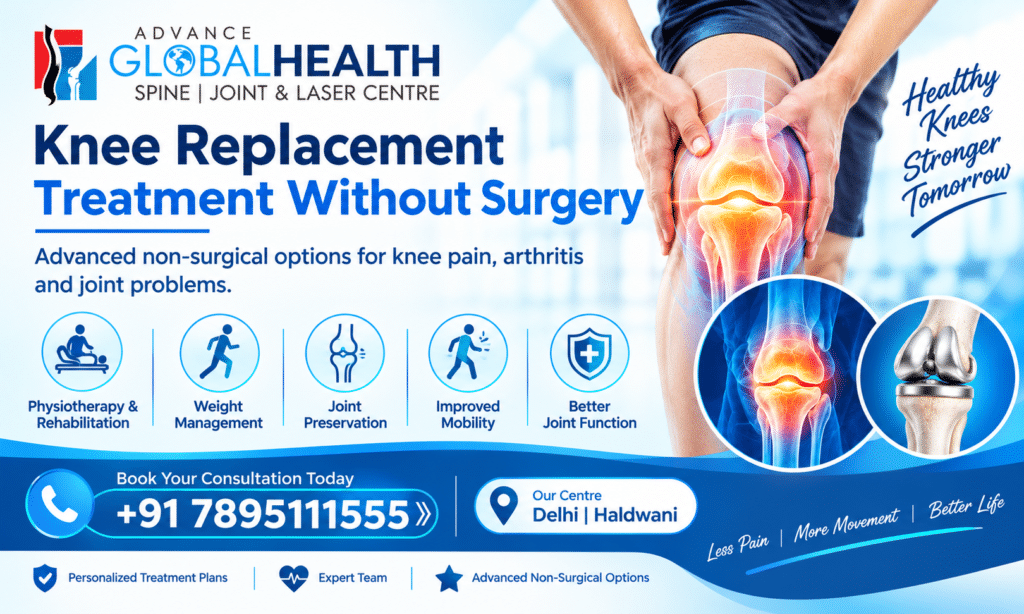
Knee pain and osteoarthritis can gradually affect walking, climbing stairs, exercising, and even simple daily activities. When knee pain becomes persistent or X-rays show significant arthritis, many patients begin to wonder whether knee replacement surgery is the only solution.
The answer is not always yes. Depending on the cause and severity of knee problems, many patients can explore Knee Replacement Treatment Without Surgery through comprehensive non-surgical management. The goal is generally to reduce pain, improve mobility, strengthen the muscles supporting the knee, and maintain joint function for as long as medically appropriate.
At Advance Global Health – Spine | Joint & Laser Centre, treatment is personalized according to the patient’s symptoms, clinical examination, imaging findings, activity level, and overall health.
People Also Like to read this: Best Avascular Necrosis Treatment in India: A Complete Guide
What Does “Knee Replacement Treatment Without Surgery” Mean?
Knee replacement is a surgical procedure in which damaged portions of the knee joint are replaced with artificial components. However, not every person with knee pain or arthritis needs immediate knee replacement.
When patients search for Knee Replacement Treatment Without Surgery, they are usually looking for treatment options that may help them manage their knee condition and potentially delay or avoid replacement surgery when clinically appropriate.
Non-surgical care may focus on:
- Reducing knee pain and stiffness
- Improving mobility
- Strengthening muscles around the knee
- Improving balance and movement
- Supporting daily activities
- Managing weight and lifestyle factors
- Addressing contributing causes of knee pain
Whether these approaches are appropriate depends on the individual’s diagnosis and the degree of joint damage.
Common Causes of Knee Pain
Osteoarthritis is one of the most common causes of chronic knee pain, but it is not the only one. Knee symptoms can also result from previous injuries, ligament problems, meniscus injuries, overuse, inflammation, alignment problems, or other joint conditions.
Common symptoms include:
- Persistent knee pain
- Stiffness after sitting or resting
- Swelling
- Difficulty walking
- Pain while climbing or descending stairs
- Difficulty standing for long periods
- Reduced range of motion
- Clicking or grinding sensations
- Weakness or instability
An accurate diagnosis is important before deciding whether non-surgical treatment is appropriate.
Can Knee Replacement Be Avoided?
For some patients, appropriate non-surgical management may improve symptoms and function and may allow them to postpone knee replacement. However, it is important to have realistic expectations.
The possibility of managing knee pain without replacement depends on factors such as:
- Severity of arthritis
- Degree of cartilage and joint damage
- Pain intensity
- Mobility limitations
- Knee alignment and stability
- Imaging findings
- Response to previous treatment
- Overall health and activity level
Patients with severe structural damage and disabling symptoms may still require a surgical consultation.
Therefore, Knee Replacement Treatment Without Surgery in Delhi should not mean avoiding surgery at all costs. Instead, it should involve a proper assessment to determine whether non-surgical management can reasonably meet the patient’s treatment goals.
Non-Surgical Knee Pain Treatment in Delhi
1. Physiotherapy and Rehabilitation
Structured physiotherapy is an important component of non-surgical knee care. Exercise can help strengthen the muscles supporting the knee and improve mobility and physical function.
A personalized rehabilitation programme may include:
- Quadriceps strengthening
- Hamstring and hip strengthening
- Flexibility exercises
- Range-of-motion exercises
- Balance training
- Functional movement training
- Walking and gait improvement
The American Academy of Orthopaedic Surgeons recommends exercise and physical activity as important components of managing symptomatic knee osteoarthritis.
At Advance Global Health, rehabilitation can be adapted according to the patient’s condition, mobility, and treatment goals.
2. Weight Management
For people who are overweight, weight management can be an important part of knee arthritis care. Additional body weight increases mechanical stress on the knee.
Current AAOS guidance recommends sustained weight loss to improve pain and function in overweight and obese patients with knee osteoarthritis.
Weight management should be gradual and appropriate to the individual’s overall health rather than based on extreme diets or excessive exercise.
3. Activity Modification
Complete rest is not usually the objective of long-term knee rehabilitation. Instead, activities that repeatedly aggravate symptoms may need to be modified.
Depending on the condition, patients may benefit from:
- Low-impact exercise
- Walking at an appropriate level
- Swimming or cycling
- Reducing repetitive high-impact activities
- Avoiding prolonged positions that increase symptoms
- Using supportive footwear
The goal is to remain active while avoiding unnecessary stress on the affected joint.
4. Pain Management
Pain can make it difficult to exercise or participate in rehabilitation. Depending on the patient’s medical history, a doctor may recommend appropriate pain-management strategies.
Medication should be used under medical supervision, particularly in people with other medical conditions or those taking other medicines.
5. Laser-Based Treatment
Laser-based treatment may be considered as part of a broader non-surgical knee pain management programme for selected patients.
Recent research and clinical reviews suggest that high-intensity laser treatment may help reduce pain and improve function in people with knee osteoarthritis, particularly when combined with exercise. However, laser treatment should not be considered a guaranteed cure or a substitute for proper diagnosis and rehabilitation.
At Advance Global Health, laser-based care may be combined with physiotherapy, strengthening, mobility training, and other clinically appropriate approaches depending on the patient’s condition.
6. Supportive Devices and Other Treatments
Some patients may benefit from supportive devices such as knee braces, depending on the type of knee problem and stability requirements.
In selected cases, doctors may also consider image-guided injections or other interventions for symptom management. The suitability of these options depends on the patient’s diagnosis and should be determined by a qualified specialist.
Knee Replacement Treatment Without Surgery in Noida
Patients searching for Knee Replacement Treatment Without Surgery in Noida may consider a comprehensive evaluation before deciding that knee replacement is their only option.
The first step should be identifying the underlying cause of knee pain and determining the extent of joint damage. Depending on the findings, a treatment plan may include rehabilitation, exercise, weight management, pain management, lifestyle modification, and selected advanced non-surgical approaches.
Patients from Noida and surrounding areas can seek a specialist assessment in Delhi to understand whether their knee condition may be appropriately managed without immediate replacement surgery.
Knee Replacement Treatment Without Surgery in Delhi
For people looking for Knee Replacement Treatment Without Surgery in Delhi, Advance Global Health follows a personalized approach to knee and joint care.
The assessment may include:
- Detailed medical history
- Physical examination
- Knee mobility assessment
- Muscle strength assessment
- Walking and functional assessment
- Review of X-rays or MRI when required
- Evaluation of previous treatments
- Discussion of lifestyle and activity levels
The purpose is to understand the patient’s condition before selecting an appropriate treatment pathway.
Advance Global Health’s Delhi centre is located at 106, near Gate No. 1, Block D, Panchsheel Enclave, New Delhi – 110017. The centre provides non-surgical spine and joint care, including rehabilitation and advanced treatment approaches.
Knee Replacement Treatment Without Surgery in India
The availability of modern rehabilitation and conservative treatment options means patients across India can discuss alternatives to immediate knee replacement with qualified specialists.
However, Knee Replacement Treatment Without Surgery in India should always be based on individual assessment rather than a promise that surgery can be avoided in every case.
Non-surgical treatment may be particularly useful when symptoms can be managed and the patient can maintain acceptable function. In advanced arthritis, however, significant structural damage may make surgical evaluation appropriate.
When Is Knee Replacement Considered?
Knee replacement may be considered when a patient has severe arthritis and symptoms continue to significantly affect quality of life despite appropriate non-surgical management.
Factors that may lead a specialist to discuss replacement include:
- Severe persistent pain
- Major difficulty walking
- Pain affecting sleep
- Significant limitation of daily activities
- Advanced structural joint damage
- Poor response to appropriate conservative treatment
The decision should be individualized rather than based solely on an X-ray or a particular age.
Why Choose Advance Global Health?
At Advance Global Health, the focus is on personalized and comprehensive joint care. The treatment approach may combine rehabilitation, strengthening, lifestyle guidance, pain management, laser-based treatment, and other selected non-surgical options when clinically appropriate.
The objective is to help patients understand their condition, improve mobility, manage symptoms, and make informed decisions about their long-term joint health.
Conclusion
Knee Replacement Treatment Without Surgery may be an appropriate approach for selected patients depending on the severity and cause of knee pain. Physiotherapy, strengthening exercises, weight management, activity modification, pain management, and selected advanced non-surgical treatments may help reduce symptoms and improve function.
However, non-surgical treatment cannot guarantee that every patient will avoid knee replacement. When arthritis is advanced and pain or disability remains severe despite appropriate treatment, surgical evaluation may be necessary.
If you are searching for Knee Replacement Treatment Without Surgery in Delhi, Knee Replacement Treatment Without Surgery in Noida, or Knee Replacement Treatment Without Surgery in India, an early professional evaluation can help you understand your options and choose a treatment plan appropriate for your individual condition.
