
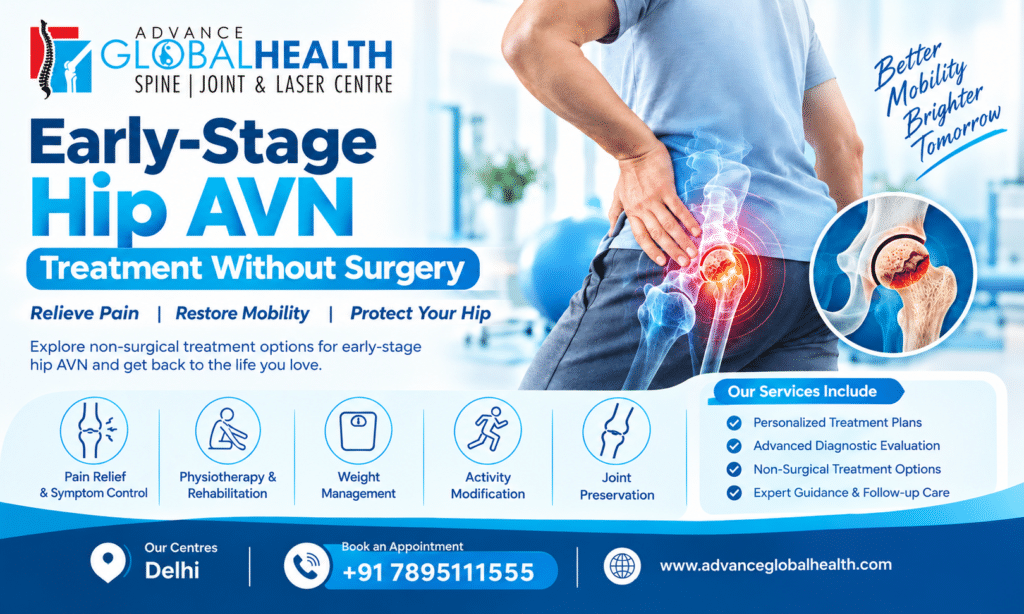
Early-Stage Hip AVN Treatment Without Surgery can be possible in selected patients when avascular necrosis (AVN) is detected before significant collapse of the femoral head occurs. Early diagnosis, appropriate activity modification, rehabilitation, and a carefully planned treatment strategy may help manage symptoms and protect hip function.
At Advance Global Health, the approach to Hip AVN Treatment focuses on understanding the stage of the condition, the extent of bone involvement, symptoms, and individual lifestyle requirements before deciding on a treatment plan.
People Also Like to read this: Hip Pain & AVN Treatment Without Surgery in Delhi
What Is Hip AVN?
Avascular necrosis of the hip, also called osteonecrosis of the femoral head, occurs when the blood supply to part of the femoral head becomes impaired. Reduced blood flow can damage bone tissue and, if the condition progresses, may eventually lead to weakening and collapse of the femoral head.
Because the hip is a weight-bearing joint, progression of AVN can cause pain, stiffness and difficulty walking.
Some common symptoms include:
- Hip or groin pain
- Pain while walking or standing
- Reduced hip movement
- Pain that may extend toward the thigh or buttock
- Difficulty climbing stairs
- Limping
- Increasing discomfort with weight-bearing activities
However, early-stage AVN may cause few or no symptoms, which is why appropriate imaging and medical assessment can be important when AVN is suspected.
Why Early Diagnosis Matters
The stage at which AVN is diagnosed can significantly influence treatment planning.
In early disease, the femoral head may still maintain its overall shape without significant structural collapse. This provides an opportunity to consider conservative and non-surgical approaches aimed at reducing stress on the hip and maintaining mobility.
Once substantial collapse or advanced joint damage occurs, treatment options can become more complex.
For this reason, people experiencing persistent hip or groin pain—particularly those with known risk factors for AVN—should seek appropriate medical evaluation rather than waiting for symptoms to become severe.
Can Early-Stage Hip AVN Be Treated Without Surgery?
In selected cases, Early-Stage Hip AVN Treatment Without Surgery may be considered.
The objective is generally to manage symptoms, reduce excessive loading of the affected hip, maintain mobility and address factors that could contribute to disease progression.
A non-surgical treatment plan may include several components.
1. Activity Modification
Excessive weight-bearing and high-impact activities can increase mechanical stress on an affected hip.
Depending on the individual’s condition, a specialist may recommend temporarily reducing activities such as:
- Running
- Jumping
- High-impact sports
- Long periods of standing
- Activities that significantly increase hip pain
Activity modification does not necessarily mean complete inactivity. Appropriate movement and rehabilitation can remain important.
2. Physiotherapy and Rehabilitation
A structured rehabilitation programme can help maintain hip mobility and support the muscles surrounding the hip and pelvis.
Exercises may focus on:
- Hip range of motion
- Gluteal strength
- Core stability
- Lower-limb strength
- Balance and movement control
Exercises should be selected according to the stage of AVN and the individual’s symptoms. High-impact or inappropriate exercises may place unnecessary stress on the joint.
3. Weight Management
Maintaining a healthy body weight can reduce the mechanical load placed on the hips during everyday activities.
For people who are overweight, gradual and medically appropriate weight management may form part of an overall AVN Treatment Without Surgery strategy.
4. Managing Pain and Symptoms
Pain management may be included when necessary to help a person remain mobile and participate in rehabilitation.
The appropriate approach depends on the individual’s medical history, medications, symptoms and other health factors. Pain relief should be viewed as part of a broader treatment plan rather than as treatment of the underlying AVN itself.
5. Addressing Risk Factors
AVN can have several possible causes and risk factors. These can include certain medications, alcohol exposure, previous trauma, some medical conditions and other factors affecting blood supply to bone.
A specialist may review the individual’s history and identify potentially modifiable factors.
Addressing relevant risk factors can be an important part of comprehensive Hip AVN Treatment.
What Happens If AVN Progresses?
Early-stage AVN should not be considered automatically cured simply because symptoms improve.
The condition can progress in some patients, and structural changes may occur even when symptoms are limited. Follow-up assessment and imaging may therefore be recommended to monitor the hip.
If the femoral head begins to collapse or significant joint damage develops, non-surgical treatment may become less effective, and surgical options may need to be discussed.
This is why early diagnosis and appropriate monitoring are important.
Who May Be Suitable for Non-Surgical AVN Treatment?
Not every patient with AVN will have the same treatment plan.
Factors that may influence treatment decisions include:
- Stage of AVN
- Size and location of the affected area
- Whether femoral-head collapse has occurred
- Severity of pain
- Hip mobility
- Age and activity level
- Underlying cause or risk factors
- Other medical conditions
- Response to previous treatment
A person with early-stage disease and a preserved femoral head may have different options from someone with advanced structural collapse.
Therefore, Avascular Necrosis Treatment in India should be individualized rather than based solely on the diagnosis of AVN.
Hip AVN Treatment in Haldwani
People looking for Avascular Necrosis Treatment in Haldwani may benefit from an evaluation that considers both symptoms and the structural condition of the hip.
At Advance Global Health, assessment and treatment planning can focus on the stage of AVN, functional limitations and appropriate rehabilitation or non-surgical care where clinically suitable.
The goal of early management is to help patients understand their condition and make informed decisions about their available treatment options.
Why Regular Monitoring Matters
One of the biggest mistakes people can make after an AVN diagnosis is assuming that the absence of severe pain means the condition has stopped progressing.
AVN can behave differently from person to person. Monitoring allows clinicians to evaluate changes in symptoms and, when appropriate, imaging findings.
Patients should report changes such as:
- Increasing hip pain
- New difficulty walking
- Reduced hip movement
- Increasing limp
- Difficulty performing normal activities
- Pain that occurs even at rest
Early reassessment can help determine whether the existing treatment strategy should be modified.
When Might Surgery Be Considered?
The phrase AVN Treatment Without Surgery should not be interpreted as meaning that surgery is never required.
If the femoral head has collapsed significantly or the hip joint has developed advanced degenerative changes, surgical treatment may need to be considered.
The appropriate option depends on the patient’s age, disease stage, structural damage, symptoms and functional requirements.
The earlier AVN is identified, the more opportunity there may be to discuss joint-preserving and conservative strategies before advanced damage develops.
Conclusion
Early-Stage Hip AVN Treatment Without Surgery may be appropriate for selected patients, particularly when the femoral head has not undergone significant collapse. Treatment may involve activity modification, physiotherapy, rehabilitation, symptom management, weight management and addressing relevant risk factors.
However, AVN is a condition that requires proper assessment and monitoring. There is no single treatment that is appropriate for every patient, and non-surgical care cannot guarantee prevention of progression.
If you have been diagnosed with AVN or are experiencing persistent hip or groin pain, an early evaluation can help determine the stage of the condition and the most appropriate treatment options.
Advance Global Health provides care for spine and joint conditions with centres in Delhi and Haldwani. Patients can discuss their symptoms and available treatment options with the clinical team before deciding on the next step.

Pingback: Best Avascular Necrosis Treatment in India | Advance Global Health