
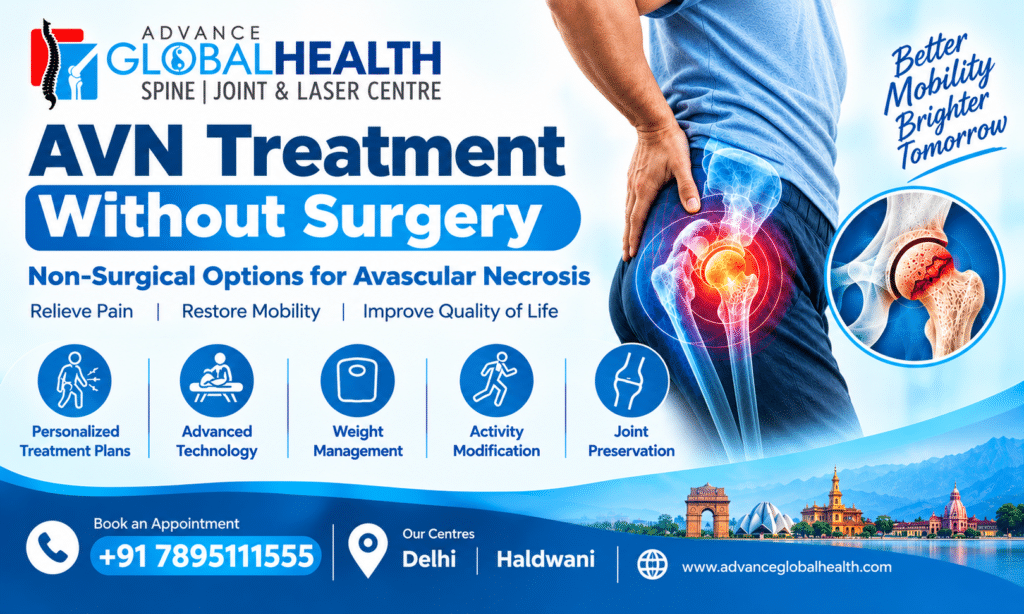
Avascular necrosis (AVN) is a bone condition that develops when the blood supply to a bone is reduced, causing bone tissue to weaken and potentially collapse over time. It commonly affects the hip joint, particularly the femoral head, and may cause pain, stiffness and difficulty walking. Early diagnosis and appropriate treatment planning are important for managing the condition and preserving joint function wherever possible.
For people searching for AVN treatment without surgery in Mumbai, understanding the stage of AVN, the extent of bone damage and the available treatment options is an essential first step. Advance Global Health focuses on spine and joint care, with an emphasis on individualized assessment, rehabilitation and appropriate treatment planning for patients with joint conditions.
Although non-surgical management may be suitable for selected patients, it cannot guarantee that AVN will stop progressing or that surgery will never be necessary.
People Also Like to read this: Knee Replacement Treatment Without Surgery in Delhi: A Complete Guide
What Is Avascular Necrosis (AVN)?
Avascular necrosis, also known as osteonecrosis, occurs when the blood supply to part of a bone becomes impaired. Without adequate blood flow, bone cells may become damaged, weakening the affected area.
The hip is one of the most frequently affected joints. AVN can also occur in other bones, including the knee and shoulder.
Common symptoms include:
- Pain in the hip or groin
- Discomfort while walking or standing
- Reduced hip movement
- Pain extending toward the thigh or buttock
- Difficulty climbing stairs
- Limping or difficulty bearing weight
- Pain that may become more persistent as the condition progresses
In the early stages, some people experience few symptoms. As the condition advances, structural changes in the bone can cause increasing pain and mobility limitations.
Causes and Risk Factors of AVN
AVN can develop for several reasons. Identifying potential risk factors helps clinicians understand the patient’s medical history and plan appropriate care.
Common risk factors include:
- Long-term or high-dose corticosteroid use
- Excessive alcohol consumption
- Previous hip injury or fracture
- Certain blood disorders
- Some autoimmune or other medical conditions
- Previous radiation treatment
- Cases in which the exact cause remains unknown
Not everyone with these risk factors develops AVN. A medical evaluation is necessary to understand the likely cause and determine the next steps.
Can AVN Be Treated Without Surgery in Mumbai?
AVN treatment without surgery in Mumbai may be an option for selected patients, particularly when the condition is identified before significant collapse of the femoral head.
The suitability of non-surgical treatment depends on several factors, including the stage of AVN, the size and location of the affected area, pain severity, imaging findings and the patient’s daily activity requirements.
Non-surgical treatment generally aims to manage symptoms, reduce excessive stress on the affected joint, preserve mobility and address relevant risk factors.
Possible components of a treatment plan include:
1. Activity Modification
Reducing excessive stress on the affected hip may be recommended to limit mechanical loading.
Depending on the severity of AVN, a clinician may advise reducing high-impact activities such as running, jumping or prolonged standing. Some patients may require temporary use of walking aids to reduce weight-bearing.
Activity modification should be individualized. Complete inactivity is not appropriate for everyone, and a clinician can recommend safe movement based on the condition.
2. Physiotherapy and Rehabilitation
Physiotherapy may help maintain joint mobility, improve muscle strength and support functional movement.
A rehabilitation programme may include:
- Gentle range-of-motion exercises
- Hip and pelvic muscle strengthening
- Core stability exercises
- Balance and movement training
- Guidance on safe walking and daily activities
Exercise selection is important because high-impact activities or unsuitable loading may aggravate symptoms.
Physiotherapy can support function and mobility, but it does not independently restore the blood supply to damaged bone or guarantee that AVN will not progress.
3. Pain and Symptom Management
Pain management may help patients perform daily activities more comfortably. Depending on the patient’s medical history, clinicians may recommend appropriate medicines or other supportive measures.
Medication should be used under medical guidance, particularly for people with kidney, stomach, cardiovascular or other health concerns.
Pain relief alone does not establish that the underlying bone damage has improved. Continued assessment may be necessary even if symptoms become less severe.
4. Weight Management and Lifestyle Changes
Maintaining a healthy weight can reduce the mechanical load placed on the hip joints.
Lifestyle recommendations may include maintaining appropriate physical activity, following a balanced diet, avoiding excessive alcohol and discussing medication-related risk factors with the treating clinician.
Patients should not discontinue prescribed corticosteroids or other medication without consulting the prescribing doctor.
5. Regular Clinical Assessment
Follow-up examinations and imaging can help clinicians assess whether AVN is stable or progressing.
MRI is particularly useful for detecting early AVN, while X-rays can help identify structural changes and femoral-head collapse. The appropriate imaging schedule depends on the individual’s condition.
Monitoring is important because symptoms alone do not always reflect the extent of bone damage.
Understanding AVN 3rd Stage Treatment in Mumbai
People searching for AVN 3rd Stage Treatment in Mumbai should understand that Stage 3 generally indicates more advanced disease, often involving a subchondral fracture or early collapse of the femoral head. Exact staging terminology can vary, so imaging findings and the staging system used by the treating specialist matter.
At this stage, treatment decisions require careful evaluation because the structural integrity of the hip may already be affected.
Treatment planning may consider:
- The extent of femoral-head collapse
- The size and location of the affected bone area
- Severity of pain and mobility limitations
- Whether the joint surface remains reasonably preserved
- Age, general health and activity requirements
- Previous treatment and response
Non-surgical care may still help manage symptoms and maintain function in some cases. However, it may not prevent further collapse or be sufficient for advanced disease.
Depending on the findings, an orthopaedic specialist may discuss joint-preserving procedures or, where substantial damage has occurred, hip replacement. The appropriate approach must be determined through individual clinical assessment.
There is no guaranteed non-surgical treatment for Stage 3 AVN. Early specialist evaluation can help patients understand the realistic benefits, limitations and risks of each option.
Avascular Necrosis Treatment in Mumbai: What to Expect
When considering Avascular Necrosis Treatment in Mumbai, patients should look for a treatment plan that considers the complete clinical picture rather than focusing only on pain relief.
An appropriate evaluation may involve:
1. Medical history: Reviewing symptoms, injuries, medication use and relevant risk factors.
2. Physical examination: Assessing pain, walking ability and hip movement.
3. Imaging review: Evaluating X-rays or MRI findings to determine the extent of AVN.
4. Stage assessment: Establishing whether the femoral head remains intact or has started to collapse.
5. Individualized planning: Discussing conservative care, rehabilitation and any indicated surgical options.
6. Follow-up: Monitoring symptoms, function and disease progression.
Patients should also ask about expected outcomes, treatment limitations, possible complications and the need for further imaging.
AVN Care at Advance Global Health
Advance Global Health provides spine and joint care, with centres in Delhi and Haldwani. Its approach to joint conditions emphasizes understanding the patient’s symptoms, functional needs and clinical findings before developing an appropriate care plan.
For patients exploring AVN management, the first step is to establish the stage of the condition and determine which options are medically appropriate. Rehabilitation and non-surgical measures may form part of care when indicated, while patients with significant structural damage may need assessment by an orthopaedic surgeon.
Patients based in Mumbai should confirm service availability and consultation arrangements directly with Advance Global Health before planning travel.
When Should You Seek Medical Advice?
Do not delay assessment if you have persistent hip or groin pain, difficulty walking, worsening stiffness or increasing pain during weight-bearing.
Seek prompt medical evaluation if you suddenly become unable to bear weight or develop severe hip pain, especially after an injury.
Early assessment can help identify the condition, establish its stage and clarify the available treatment options.
Conclusion
AVN treatment without surgery in Mumbai may be appropriate for selected patients, particularly when the condition is diagnosed before significant femoral-head collapse. Activity modification, supervised rehabilitation, symptom management, risk-factor management and regular monitoring may help support joint function.
For patients requiring AVN 3rd Stage Treatment in Mumbai, the decision is more complex because structural damage may already be present. Non-surgical care can help with symptoms in some cases, but it cannot guarantee that further bone collapse or surgery will be avoided.
Advance Global Health encourages patients to seek an appropriate clinical assessment, understand their AVN stage and make informed decisions about treatment. The goal is to identify the most suitable approach for each individual while setting realistic expectations for pain, mobility and long-term joint health.
