
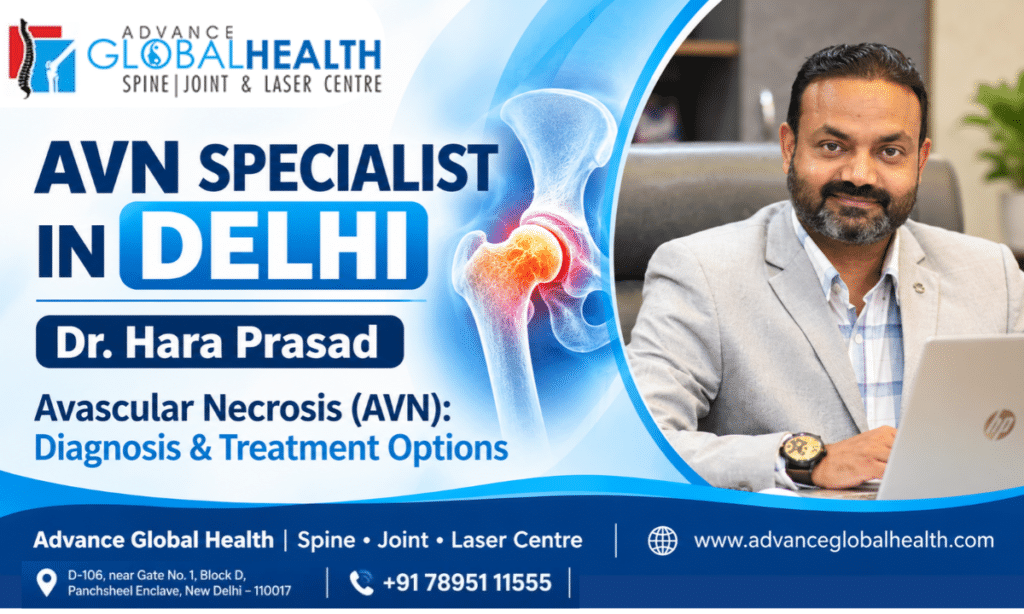
Avascular Necrosis (AVN) is a bone condition that develops when the blood supply to a bone is reduced, causing bone tissue to weaken and potentially collapse over time. The hip joint is one of the most commonly affected areas. Without appropriate assessment and monitoring, AVN can progress and lead to persistent pain, reduced mobility and damage to the hip joint.
For people searching for an AVN specialist in Delhi, understanding the condition, its stages and available treatment options is an important first step. At Advance Global Health – Spine, Joint & Laser Centre, Dr. Hara Prasad focuses on spine and joint care, including AVN management, with an emphasis on personalized assessment and non-surgical approaches where clinically appropriate.
Located in Panchsheel Enclave, New Delhi, Advance Global Health provides patients with an opportunity to discuss their symptoms, review their diagnostic findings and understand treatment options suited to their condition.
Who Is Dr. Hara Prasad?
Dr. Haraprasad is an orthopaedic rehabilitation specialist with over 18 years of clinical experience in the management of spine, joint, and neurological conditions. As the Founder and CEO of Advance Global Health, he is committed to providing advanced non-surgical regenerative therapies and rehabilitation-based treatment solutions aimed at preventing unnecessary surgeries, improving mobility, and enhancing quality of life.
Patients looking for an AVN specialist Doctor in Delhi should seek a professional who can help them understand their diagnosis, the stage of the disease and the potential benefits and limitations of available treatments.
AVN can require multidisciplinary care. Depending on the stage and extent of bone damage, patients may also need assessment by an orthopaedic surgeon.
What Is Avascular Necrosis (AVN)?
Avascular necrosis, also known as osteonecrosis, occurs when reduced blood supply damages bone tissue. In hip AVN, the condition affects the femoral head, the rounded upper part of the thigh bone that fits into the hip joint.
As the condition progresses, the affected bone may weaken and lose its structural strength. In advanced cases, the femoral head can collapse, potentially leading to secondary arthritis and significant mobility problems.
Common symptoms of AVN include:
- Pain in the hip or groin
- Discomfort while standing or walking
- Pain that may extend to the thigh or buttock
- Stiffness and reduced hip movement
- Difficulty climbing stairs
- Limping or difficulty bearing weight
Some people have few symptoms during the early stages. Therefore, persistent hip pain should be evaluated rather than ignored.
What Causes AVN?
AVN can develop due to several factors that affect blood circulation to bone tissue. Commonly recognized risk factors include:
- Prolonged or high-dose corticosteroid use
- Excessive alcohol consumption
- Previous trauma, fracture or dislocation
- Certain blood disorders
- Some autoimmune and other medical conditions
- Cases where the underlying cause cannot be identified
Having a risk factor does not necessarily mean that a person will develop AVN. A detailed medical history and appropriate investigations help establish the diagnosis and guide treatment planning.
Why Early AVN Diagnosis Matters
Early diagnosis can be important because treatment decisions depend significantly on whether the femoral head has maintained its structure.
AVN is commonly classified into stages, although the exact terminology varies between staging systems.
Early-stage AVN: The bone may show changes on MRI before obvious abnormalities appear on X-rays. The femoral head has not collapsed.
Intermediate-stage AVN: Structural changes may become more apparent, and the risk of bone weakening or collapse becomes an important consideration.
Advanced-stage AVN: The femoral head may have collapsed, and the hip joint may develop significant degenerative changes.
MRI is particularly useful for detecting early AVN, while X-rays help assess structural changes. A specialist can review the available imaging and determine whether further investigation is necessary.
AVN Treatment Options in Delhi
People searching for an AVN specialist in Delhi often want to understand whether treatment without surgery is possible.
The answer depends on the stage of AVN, the size and location of the affected area, the presence of bone collapse, symptoms and the patient’s overall health.
Treatment planning may include the following approaches.
1. Activity Modification
Reducing excessive loading on the affected hip may help manage symptoms. Depending on the condition, a clinician may recommend limiting high-impact exercise, prolonged standing or activities that aggravate pain.
Walking aids may sometimes be advised to reduce weight-bearing stress.
2. Micro-Circulation Repairing System
A carefully designed rehabilitation programme may help maintain hip mobility, strengthen supporting muscles and improve functional movement.
Exercises should be selected according to the individual’s symptoms and disease stage. High-impact activities or unsuitable exercises may place unnecessary stress on the affected joint.
Physiotherapy can support mobility and function, but it cannot guarantee that AVN will stop progressing.
3. Non-Invasive Treatment
Appropriate Non-Invasive Treatment may help patients participate in daily activities and rehabilitation more comfortably. Medicines should be selected by a qualified clinician according to the patient’s medical history and other medications.
Pain relief does not necessarily indicate that the underlying bone damage has healed. Follow-up assessment may still be required.
4. Joint-Preserving Treatment Options
Selected patients may be considered for procedures intended to preserve the hip joint, depending on the stage and structural condition of the femoral head. Core decompression is one example of a joint-preserving surgical procedure that may be considered in appropriate cases.
The potential benefits and limitations of each approach should be discussed with the treating specialist.
5. Advanced AVN Management
Advance Global Health describes its approach as incorporating non-surgical technologies and individualized rehabilitation where appropriate. Patients can discuss the available treatments with the clinical team and ask about the evidence, expected outcomes, limitations and suitability for their specific stage of AVN.
No treatment should be presented as a guaranteed way to reverse AVN or prevent surgery in every patient. When substantial femoral-head collapse has occurred, hip replacement may be an appropriate option for some individuals.
Why Choose Advance Global Health for AVN Care in Delhi?
Advance Global Health – Spine, Joint & Laser Centre offers care for AVN and other spine and joint conditions. Its approach emphasizes understanding each patient’s symptoms, reviewing diagnostic findings and developing an individualized treatment plan.
Patients considering the centre can discuss:
- Their current AVN stage and imaging findings
- Available conservative and non-surgical options
- Whether specialist orthopaedic assessment is necessary
- Rehabilitation and activity recommendations
- Follow-up requirements
- The expected benefits, risks and limitations of treatment
An informed discussion can help patients make decisions based on their clinical condition rather than relying on general claims about treatment.
When Should You Consult an AVN Specialist?
Consider seeking medical assessment if you experience persistent hip or groin pain, stiffness, difficulty walking or discomfort while bearing weight. People already diagnosed with AVN should follow their recommended monitoring plan, even if their symptoms improve.
Seek prompt medical attention if you suddenly cannot bear weight or develop severe hip pain, particularly following an injury.
Early assessment may help clarify the diagnosis, establish the stage and identify appropriate treatment options.
Book an AVN Consultation in Delhi
If you are searching for an AVN specialist Doctor in Delhi, Advance Global Health can be contacted to enquire about AVN assessment and available treatment options.
Advance Global Health – Spine, Joint & Laser Centre
Doctor: Dr. Hara Prasad
Address: D-106, near Gate No. 1, Block D, Panchsheel Enclave, New Delhi – 110017
Contact: +91 7895111555 / +91 7830111555
Conclusion
Finding an appropriate AVN specialist in Delhi is an important step toward understanding avascular necrosis and making informed decisions about treatment. Early diagnosis, accurate staging and regular monitoring can help guide the management plan.
Dr. Hara Prasad at Advance Global Health focuses on spine and joint care, including AVN management and non-surgical approaches where clinically appropriate. However, treatment must be individualized, and some patients may require orthopaedic procedures or hip replacement depending on the extent of bone damage.
If you are experiencing persistent hip pain or have been diagnosed with AVN, seek a professional assessment to understand your condition and the options available to you.

Pingback: L4-L5 Disc Bulge Treatment: Symptoms, Causes & Recovery