
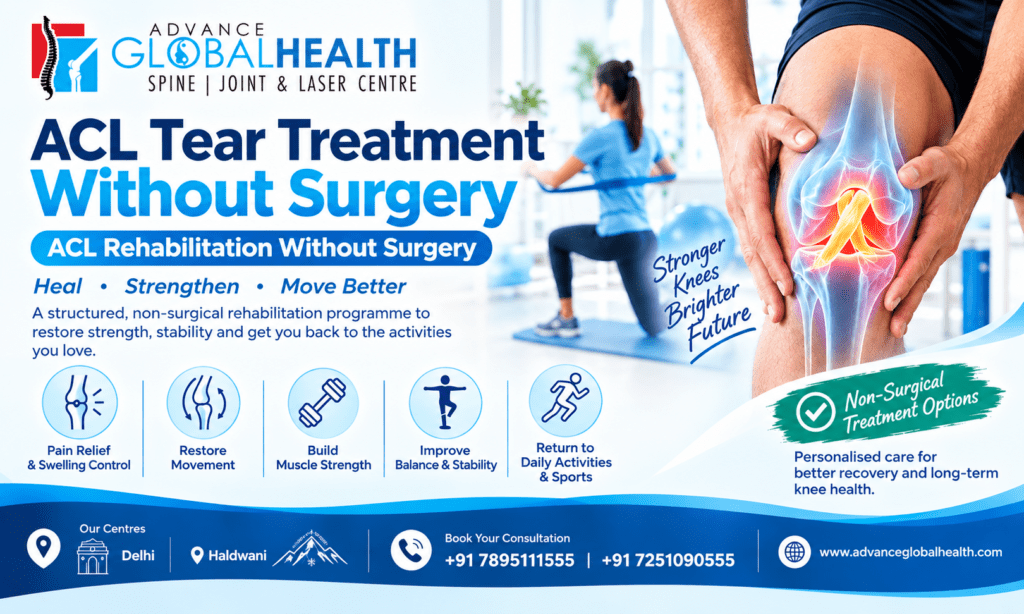
An ACL tear is one of the most common knee injuries, particularly among athletes and people involved in activities that require sudden changes in direction, jumping, or pivoting. An injury to the anterior cruciate ligament (ACL) can cause pain, swelling, instability, and difficulty returning to normal activities.
A common question after an ACL injury is: Can an ACL tear heal or be managed without surgery?
In selected patients, ACL rehabilitation without surgery may be an appropriate treatment approach. However, the decision depends on factors such as the severity and type of tear, knee stability, associated injuries, activity level, and individual goals. Not every ACL injury can or should be treated in the same way.
At Advance Global Health, rehabilitation is tailored to the individual’s condition and functional needs. This article explains ACL injuries, non-surgical treatment, rehabilitation, and when surgical evaluation may be necessary.
People Also Like to read this: Non-Surgical Treatment for Chronic Back Pain: A Complete Guide
What Is an ACL Tear?
The anterior cruciate ligament (ACL) is one of the major ligaments inside the knee. It helps control forward movement and rotation of the lower leg relative to the thigh.
An ACL tear can be:
- Partial, where some ligament fibres remain intact
- Complete, where the ligament is substantially or completely torn
ACL injuries frequently occur during sports such as football, basketball, cricket, tennis, and skiing, but they can also happen through falls, accidents, or sudden twisting movements.
Common symptoms include:
- A popping sensation at the time of injury
- Sudden knee pain
- Swelling within the first few hours
- Difficulty putting weight on the leg
- Reduced knee movement
- A feeling that the knee is unstable or “giving way”
An accurate diagnosis generally requires a clinical examination and, when appropriate, imaging such as an MRI.
Can an ACL Tear Be Treated Without Surgery?
In some cases, yes. ACL tear treatment without surgery may be considered for certain patients, particularly when the knee is reasonably stable, the tear is partial, the patient’s activity requirements are compatible with non-surgical management, or surgery is not currently indicated.
Non-surgical care does not simply mean resting the knee. A structured rehabilitation programme is often the central component.
The objectives may include:
- Reducing pain and swelling
- Restoring knee movement
- Improving muscle strength
- Improving balance and coordination
- Developing neuromuscular control
- Improving functional stability
- Gradually returning to appropriate activities
A healthcare professional should assess the injury before deciding whether rehabilitation without surgery is suitable.
ACL Rehabilitation Without Surgery
ACL rehabilitation without surgery is usually progressive rather than a single treatment.
The programme can change as the knee becomes stronger and more stable.
1. Managing Pain and Swelling
Immediately following an ACL injury, reducing swelling and protecting the knee can be important.
Depending on the injury, a healthcare professional may recommend appropriate measures such as activity modification, supportive devices, and medically appropriate pain management.
Reducing swelling can make it easier to restore normal knee movement and begin rehabilitation.
2. Restoring Knee Movement
After an injury, the knee can become stiff and difficult to bend or straighten.
Rehabilitation may initially focus on gradually restoring the knee’s range of motion.
Regaining comfortable, functional movement is important before progressing to more demanding strengthening exercises.
3. Strengthening the Knee
Muscle weakness is common after an ACL injury.
A rehabilitation programme may include exercises targeting:
- Quadriceps
- Hamstrings
- Gluteal muscles
- Calf muscles
- Core muscles
Improving strength can help provide better support for the knee and improve functional movement.
Exercises should be progressed according to the individual’s symptoms, strength, stability, and rehabilitation goals.
4. Balance and Neuromuscular Training
ACL injuries can affect proprioception—the body’s ability to sense the position and movement of a joint.
Balance and neuromuscular exercises may therefore form an important part of ACL rehabilitation without surgery.
These exercises can include progressively challenging:
- Single-leg balance
- Controlled stepping
- Coordination exercises
- Movement-control drills
- Functional stability exercises
The aim is to help the individual develop better control of the knee during everyday activities and, when appropriate, sport-specific movements.
Can You Walk With an ACL Tear?
Some people can walk after an ACL tear, while others may initially have significant pain, swelling, or instability.
Being able to walk does not necessarily mean that the ACL injury is minor.
If the knee repeatedly gives way, this can affect confidence and function and may place additional stress on other structures of the knee. Persistent instability should therefore be assessed by a qualified healthcare professional.
How Long Does ACL Rehabilitation Without Surgery Take?
Recovery time varies considerably.
Factors that can influence rehabilitation include:
- Type and severity of ACL injury
- Presence of partial or complete tear
- Associated meniscus or cartilage injuries
- Muscle strength
- Knee stability
- Age and general fitness
- Rehabilitation consistency
- Desired activity level
Some patients may return to normal daily activities relatively quickly, while returning to high-demand sports can require a substantially longer and more structured rehabilitation process.
There is no single recovery timeline that applies to every ACL injury.
Can a Completely Torn ACL Be Treated Without Surgery?
A complete ACL tear requires careful assessment.
Some individuals may be able to function well with rehabilitation and appropriate activity modification, particularly when the knee remains functionally stable and the person’s activity requirements are compatible with non-operative management.
However, individuals who experience significant instability, participate in pivoting or cutting sports, or have associated injuries may require discussion of surgical options.
Therefore, ACL tear treatment without surgery should not be interpreted as a guaranteed alternative to reconstruction for every complete ACL tear.
The treatment decision should be based on an individual’s examination, imaging, knee stability, activity goals, and response to rehabilitation.
When Might ACL Surgery Be Considered?
Surgical reconstruction may be considered in certain situations, particularly when there is persistent functional instability or when the individual’s activity goals require a level of knee stability that rehabilitation alone may not provide.
Surgical evaluation may become particularly relevant when:
- The knee repeatedly gives way
- There are associated meniscus or cartilage injuries
- Instability persists despite appropriate rehabilitation
- The patient wants to return to high-demand pivoting sports
- Functional goals cannot be achieved through non-operative management
A specialist can discuss the potential benefits, risks, and alternatives based on the individual’s circumstances.
ACL Rehabilitation After Injury: What Makes It Effective?
Successful rehabilitation is not simply about performing exercises every day. The programme needs to be appropriately progressed.
A comprehensive rehabilitation plan may include:
Phase 1 — Protection and Movement
Focus on controlling symptoms and restoring comfortable movement.
Phase 2 — Strength Development
Progressive strengthening of the muscles supporting the knee and hip.
Phase 3 — Stability and Control
Balance, coordination, proprioception, and functional movement training.
Phase 4 — Functional Training
More demanding movements based on the patient’s daily or sporting requirements.
Phase 5 — Return to Activity
Gradual progression toward normal activities or sport when appropriate functional criteria are met.
The exact programme should be individualised rather than following a fixed schedule.
Why Physiotherapy Matters in ACL Rehabilitation
Physiotherapy can be an important component of ACL rehabilitation without surgery.
A physiotherapist can assess:
- Knee movement
- Muscle strength
- Balance
- Walking pattern
- Functional stability
- Movement mechanics
The rehabilitation programme can then be adjusted according to progress.
This approach helps patients work toward specific functional goals rather than simply waiting for the knee to feel better.
Can You Return to Sports Without ACL Surgery?
Returning to sports after an ACL injury depends on the type of injury, knee stability, rehabilitation progress, and sport-specific demands.
Low-demand activities may be possible for some patients following successful rehabilitation.
High-demand sports involving repeated pivoting, cutting, jumping, and sudden changes in direction require greater knee stability. Athletes considering a return to such activities should undergo an appropriate functional assessment before returning to full competition.
Returning to sport too early can increase the risk of further injury.
When Should You See a Specialist?
Seek professional assessment after an injury if you experience:
- Sudden knee swelling
- A popping sensation
- Significant knee pain
- Difficulty bearing weight
- Restricted movement
- Repeated knee instability
- A feeling that the knee is giving way
Early assessment can help identify the injury and determine an appropriate treatment and rehabilitation strategy.
ACL Treatment at Advance Global Health
At Advance Global Health, the approach to ACL rehabilitation focuses on understanding the individual’s injury, symptoms, movement limitations, strength, and functional goals.
Depending on the assessment, a personalised rehabilitation programme may include progressive strengthening, mobility work, balance training, neuromuscular exercises, and functional rehabilitation.
For patients considering ACL tear treatment without surgery, professional assessment is important to determine whether non-operative rehabilitation is appropriate.
The objective is to help patients improve knee function and return to their desired level of activity as safely as possible.
Conclusion
ACL rehabilitation without surgery is possible for selected patients, but it is not appropriate for every ACL injury. The decision depends on the type and severity of the tear, knee stability, associated injuries, lifestyle, sporting demands, and response to rehabilitation.
A structured programme involving mobility, progressive strengthening, balance, neuromuscular control, and functional training may help some patients manage an ACL injury without reconstruction.
If you have suffered an ACL injury, do not rely solely on pain levels to determine its severity. A proper clinical assessment can help establish the extent of the injury and guide the most appropriate treatment pathway.
Advance Global Health provides personalised rehabilitation and musculoskeletal care designed around the individual patient’s condition and functional goals.

Pingback: Laser Treatment for Knee Pain | Knee Pain Treatment Without Surgery