
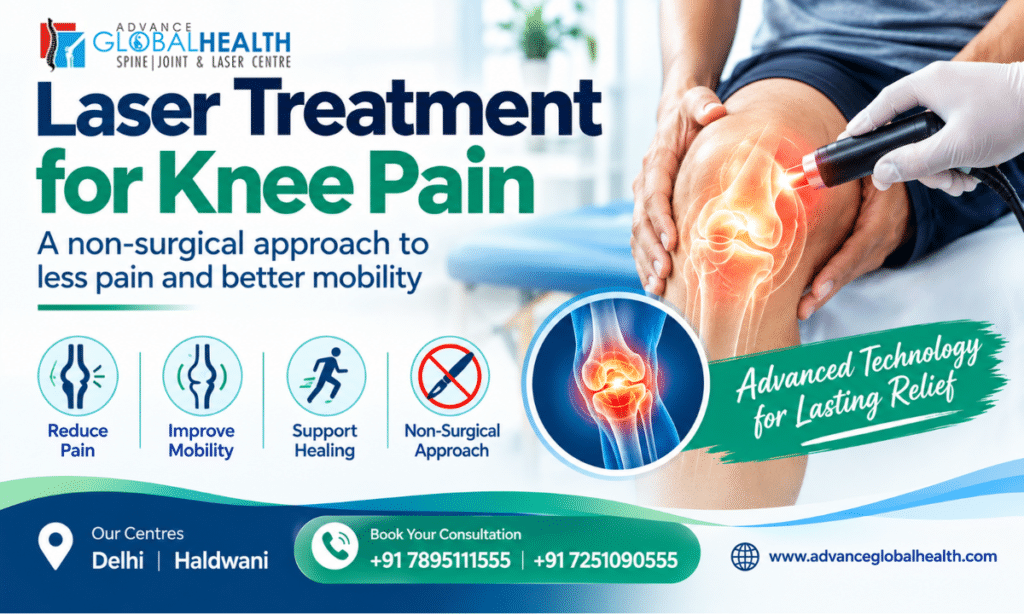
Knee pain can make everyday activities such as walking, climbing stairs, exercising, or standing for long periods increasingly difficult. It may be caused by knee osteoarthritis, sports injuries, tendon problems, overuse, inflammation, or age-related changes. For many patients, the first step is to explore conservative and non-surgical treatment options before considering an operation.
Laser Treatment for Knee Pain is one such treatment approach. Depending on the type of laser, treatment protocol, and underlying condition, laser therapy may be used as part of a broader pain-management and rehabilitation program. Research has found that high-intensity laser therapy may help reduce pain and improve function in people with knee osteoarthritis, particularly when combined with exercise. However, it should not be considered a guaranteed cure or a replacement for appropriate diagnosis and rehabilitation.
At Advance Global Health Spine | Joint & Laser Centre, knee pain is evaluated individually so that treatment can be selected according to the patient’s condition, symptoms, mobility, and treatment goals.
People Also Like to read this: ACL Tear Treatment Without Surgery: Is ACL Rehabilitation Without Surgery Possible?
What Causes Knee Pain?
Knee pain can develop for many different reasons. Common causes include:
- Knee osteoarthritis
- Previous knee injuries
- Sports-related injuries
- Tendon or ligament problems
- Repetitive stress and overuse
- Muscle weakness
Inflammation - Age-related joint changes
- Excess body weight
- Poor movement mechanics
Knee osteoarthritis is particularly common and can cause pain, stiffness, swelling, reduced range of motion, and difficulty walking. Advance Global Health notes that diagnosis may involve a clinical examination, movement and gait assessment, and imaging such as X-rays or MRI when required.
What Is Laser Treatment for Knee Pain?
Laser treatment uses specific wavelengths of light to deliver energy to targeted tissues. Depending on the technology used, laser-based treatment may be incorporated into a rehabilitation program to help manage pain and support tissue recovery.
Advance Global Health offers laser-based treatment as part of its non-surgical spine and joint care services. The centre describes its laser technology as a non-invasive treatment approach used for conditions including knee pain and arthritis.
The exact laser protocol should depend on the diagnosis, severity of symptoms, treatment area, and clinical assessment.
How Can Laser Treatment Help Knee Pain?
Research on high-intensity laser therapy has shown promising results for knee osteoarthritis. A 2023 systematic review and meta-analysis found that high-intensity laser therapy could help alleviate knee osteoarthritis pain, with evidence particularly supporting its use alongside exercise.
Potential benefits may include:
1. Pain Management
One of the main reasons patients consider Knee pain treatment by laser is pain management. Research suggests that high-intensity laser therapy may reduce pain in people with symptomatic knee osteoarthritis.
2.Supporting Mobility
Knee pain can lead people to avoid movement. Reduced activity can contribute to muscle weakness and further difficulty with everyday activities. When pain is better controlled, appropriately prescribed exercise and rehabilitation may become easier to perform.
3. Supporting Rehabilitation
Laser treatment should generally be considered as part of a broader treatment plan rather than an isolated solution. Evidence from systematic reviews suggests that laser therapy combined with exercise can improve pain and functional outcomes in knee osteoarthritis.
4. Non-Invasive Approach
Unlike injections or surgical procedures, laser treatment is a non-invasive approach. It does not require an incision and does not involve injecting medication into the knee.
Knee Pain Treatment Without Surgery
Many people with knee pain want to know whether they can improve their condition without surgery. The answer depends on the underlying cause and severity of the problem.
A comprehensive knee pain treatment without surgery program may include:
- Detailed clinical assessment
- Physiotherapy and rehabilitation
- Strengthening exercises
- Mobility and flexibility exercises
- Activity modification
- Weight-management guidance where appropriate
- Gait and movement correction
- Pain-management strategies
- Laser-based treatment when clinically appropriate
- Other selected non-surgical interventions
Advance Global Health emphasizes personalized treatment planning based on factors such as age, activity level, arthritis stage, pain severity, mobility limitations, and examination findings.
Laser Treatment and Exercise: Why Both Can Matter
Laser therapy may help with symptoms, but improving knee function requires more than simply reducing pain.
Weak quadriceps and other muscles around the knee can affect stability and movement. A structured rehabilitation program may include exercises designed to improve:
- Quadriceps strength
- Hamstring strength
- Hip strength
- Knee mobility
- Balance
- Functional movement
- Walking ability
Research evaluating laser therapy combined with exercise has reported improvements in pain and function in people with knee osteoarthritis.
Therefore, Laser Treatment for Knee Pain may be more appropriately viewed as one component of an individualized non-surgical treatment plan.
Is Laser Treatment Suitable for Everyone?
No. Knee pain can have many causes, and the same treatment is not appropriate for every patient.
Someone with early knee osteoarthritis may have very different treatment requirements from a person with a major ligament injury, advanced cartilage damage, fracture, infection, or another structural problem.
Before starting laser treatment, a specialist should evaluate:
- The cause of knee pain
- Duration and severity of symptoms
- Knee stability
- Range of motion
- Muscle strength
- Functional limitations
- Previous injuries or treatments
- Imaging findings when necessary
This assessment helps determine whether laser treatment is appropriate and whether it should be combined with physiotherapy, exercise, or other forms of care.
Can Laser Treatment Avoid Knee Replacement?
Laser treatment should not be promoted as a guaranteed way to avoid knee replacement.
Some people with knee arthritis can manage their symptoms and maintain function with non-surgical treatment, while others with advanced joint damage may eventually require surgical evaluation. Advance Global Health similarly states that treatment decisions depend on the severity and stage of arthritis and the individual’s symptoms and functional limitations.
The goal of non-surgical care is to manage pain, improve mobility, strengthen supporting muscles, and help patients maintain their daily activities whenever medically appropriate.
When Should You See a Knee Specialist?
Persistent knee pain should not be ignored, particularly when it affects walking, sleep, exercise, or everyday activities.
You should consider a professional evaluation if you experience:
- Persistent or recurring
- knee pain
- Swelling
- Increasing stiffness
- Difficulty walking
- Pain while climbing stairs
- Reduced knee movement
- Knee instability
- Clicking or grinding associated with pain
- Symptoms following an injury
Early evaluation can help identify the underlying problem and determine whether Knee pain treatment without surgery is appropriate.
Laser Treatment for Knee Pain at Advance Global Health
At Advance Global Health Spine | Joint & Laser Centre, knee conditions are assessed before an individualized treatment plan is developed. The centre provides non-surgical knee and joint care in Delhi and Haldwani, including rehabilitation and laser-based treatment approaches.
Depending on the diagnosis, treatment may involve a combination of laser-based care, physiotherapy, strengthening exercises, mobility training, lifestyle guidance, and other clinically appropriate non-surgical approaches.
The objective is to help patients manage pain, improve movement, and support better knee function while avoiding unnecessary invasive procedures whenever medically appropriate.
Conclusion
Laser Treatment for Knee Pain is an increasingly studied non-invasive option, particularly for people with knee osteoarthritis. Current research suggests that high-intensity laser therapy may help reduce pain and improve function, especially when combined with exercise and rehabilitation.
However, laser treatment is not suitable for every cause or stage of knee pain. A proper diagnosis and personalized treatment plan are essential. If you are looking for Knee pain treatment by laser or Knee pain treatment without surgery, consult a qualified specialist to determine which options are appropriate for your condition.
Advance Global Health Spine | Joint & Laser Centre provides personalized non-surgical knee and joint care in Delhi and Haldwani.

Pingback: AVN Treatment Without Surgery in Delhi | Hip Pain & AVN Care