
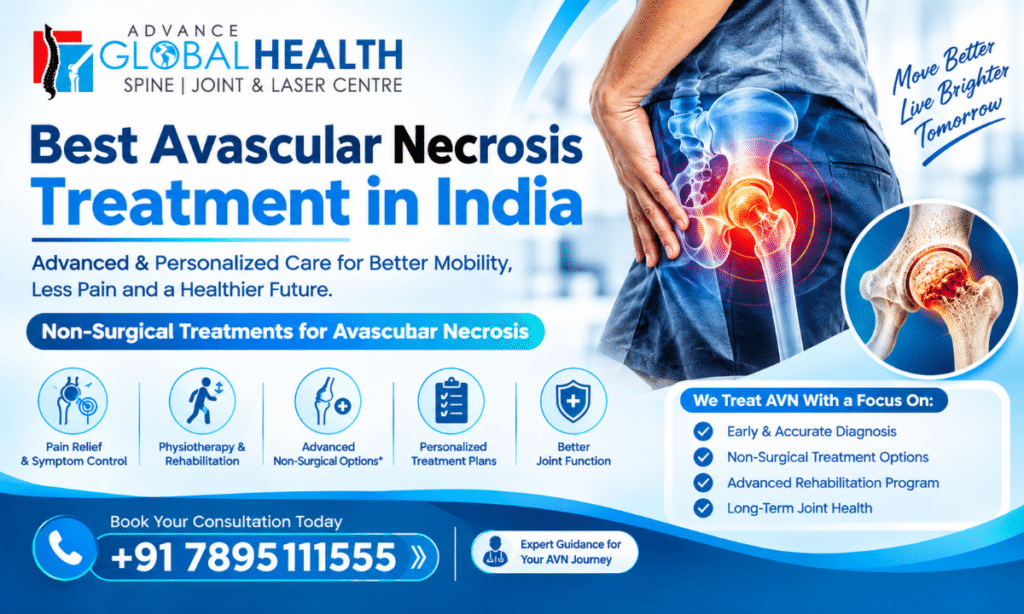
Avascular Necrosis (AVN), also known as osteonecrosis, is a condition in which the blood supply to a bone becomes reduced or interrupted. When AVN affects the hip, particularly the femoral head, reduced blood flow can damage bone tissue and may eventually lead to structural weakening or collapse. Early diagnosis is important because treatment options depend on the stage, size and location of the affected area, symptoms, and whether the femoral head has collapsed. Current international guidance emphasizes accurate staging and individualized treatment decisions.
For patients searching for the Best Avascular Necrosis Treatment in India, it is important to understand that there is no single treatment that is considered best for every patient. The most appropriate approach depends on the individual diagnosis and disease stage. At Advance Global Health – Spine | Joint & Laser Centre, treatment planning focuses on comprehensive assessment, rehabilitation, symptom management, and selected non-surgical approaches where clinically appropriate.
People Also Like to read this: Early-Stage Hip AVN: Treatment Without Surgery
What Is Avascular Necrosis?
Avascular Necrosis occurs when the blood supply to bone tissue is compromised. The femoral head of the hip is one of the most commonly affected locations. As the condition progresses, the weakened bone may develop structural damage and, in advanced cases, collapse.
Common symptoms of hip AVN include:
- Persistent hip or groin pain
- Pain while walking or standing
- Pain during weight-bearing activities
- Hip stiffness
- Reduced range of motion
- Difficulty climbing stairs
- Limping or changes in walking
- Increasing difficulty with everyday activities
Some patients may have limited symptoms during the early stages, which makes appropriate imaging and clinical assessment important.
What Causes Avascular Necrosis?
Several factors may increase the risk of AVN. These can include:
- Long-term or high-dose corticosteroid use
- Excessive alcohol consumption
- Previous hip trauma or fracture
- Certain blood disorders
- Autoimmune or systemic medical conditions
- Some treatments or medical conditions that affect blood supply
In some patients, no definite cause can be identified.
Identifying possible risk factors is an important part of Avascular necrosis Treatment in India, because addressing relevant underlying factors may form part of the overall management plan.
Why Early Diagnosis Matters in AVN
AVN treatment is strongly influenced by the stage of the disease. X-rays can help identify structural changes, but MRI is particularly valuable for detecting AVN and assessing the extent of bone involvement. A 2026 systematic review supporting the international ARCO guideline found MRI to have high diagnostic sensitivity and specificity for osteonecrosis of the femoral head.
Early-stage or pre-collapse AVN may provide more opportunities to discuss joint-preserving and conservative strategies. Once substantial femoral-head collapse or secondary joint degeneration has occurred, treatment decisions become more complex and surgical evaluation may be appropriate.
Therefore, patients with persistent hip or groin pain should not delay specialist assessment.
Non-Surgical Treatments for Avascular Necrosis
Non-Surgical Treatments for Avascular Necrosis may be considered in selected patients, particularly when the disease is identified before significant collapse. However, conservative treatment should not be presented as a guaranteed cure. Evidence indicates that conservative management alone may relieve symptoms or delay progression in some situations but does not reliably stop AVN progression.
1. Protected Weight-Bearing and Activity Modification
Reducing excessive mechanical stress on the affected hip may help manage symptoms. Depending on the patient’s condition, a specialist may recommend reducing high-impact activities or temporarily using walking support.
The exact weight-bearing recommendation should be individualized according to the extent of AVN and the patient’s symptoms.
2. Physiotherapy and Rehabilitation
Physiotherapy can support mobility, muscle strength, balance, and functional movement.
A personalized rehabilitation programme may include:
- Hip mobility exercises
- Muscle strengthening
- Balance training
- Walking and movement training
- Low-impact exercise
- Functional rehabilitation
- Activity modification
Exercise selection should take the patient’s disease stage and structural condition into account. Rehabilitation is generally part of comprehensive management rather than a standalone treatment for eliminating AVN.
3. Pain Management
Pain management may help patients maintain daily activities and participate in rehabilitation. Medication decisions should be made by a qualified healthcare professional after considering medical history, existing medications, kidney and stomach health, and other individual factors.
4. Lifestyle and Risk-Factor Management
Maintaining a healthy weight and avoiding activities that significantly aggravate symptoms may help reduce mechanical stress on the hip.
Patients should also discuss potentially modifiable AVN risk factors, such as alcohol consumption or corticosteroid exposure, with their treating doctor. Corticosteroids should never be stopped abruptly without medical advice.
5. Selected Advanced Non-Surgical Approaches
Various physical and biophysical approaches have been studied for AVN, including shockwave and electromagnetic approaches. However, the quality of evidence varies considerably between treatments, and older evidence-based guidelines did not recommend several physical modalities because of insufficient evidence for preventing disease progression.
At Advance Global Health, advanced non-surgical and rehabilitation approaches may be considered as part of an individualized treatment plan after clinical evaluation. Patients should understand the potential benefits, limitations, evidence, and alternatives before choosing any specific modality.
Can AVN Be Treated Without Surgery?
This is one of the most common questions after an AVN diagnosis.
In selected patients, particularly those with early or pre-collapse disease, non-surgical management may help control symptoms, maintain mobility, and support joint function. However, Avascular Necrosis Treatment in India should always be based on accurate staging and individual assessment.
The latest international ARCO clinical practice guideline emphasizes accurate staging, appropriate imaging, assessment of symptoms, and identification of patients who may benefit from joint-preserving interventions.
For advanced AVN with substantial femoral-head collapse, severe joint damage, or significant functional limitation, surgical options may need to be evaluated. Non-surgical treatment should therefore not be promoted as a guaranteed replacement for surgery in advanced disease.
Why Choose Advance Global Health for AVN Care?
At Advance Global Health – Spine | Joint & Laser Centre, patients receive an individualized approach to hip and joint conditions.
The treatment planning process may include:
- Review of MRI and other diagnostic reports
- Assessment of AVN stage and extent
- Evaluation of pain and mobility
- Physiotherapy and rehabilitation planning
- Activity and weight-bearing guidance
- Pain-management support
- Selected advanced non-surgical approaches where appropriate
- Ongoing monitoring and follow-up
The objective is to understand the patient’s condition before recommending a treatment pathway rather than applying the same treatment to every AVN case.
When Should You Consult an AVN Specialist?
You should consider an early medical evaluation if you experience persistent:
- Hip or groin pain
- Pain while walking
- Difficulty standing for long periods
- Hip stiffness
- Reduced hip movement
- Limping
- Increasing difficulty with stairs or daily activities
Early evaluation can help determine whether symptoms are related to AVN, arthritis, injury, or another condition and can help establish the appropriate treatment pathway.
Conclusion
The Best Avascular Necrosis Treatment in India is not necessarily one specific procedure or technology. The best approach depends on the patient’s AVN stage, lesion size and location, presence or absence of femoral-head collapse, symptoms, age, activity level, and overall health.
Avascular necrosis Treatment in India may include protected weight-bearing, activity modification, physiotherapy, rehabilitation, pain management, risk-factor management, and selected advanced approaches in appropriate patients. Non-surgical care may be particularly relevant in selected early or pre-collapse cases, but it cannot guarantee prevention of disease progression.
At Advance Global Health, the focus is on detailed assessment and personalized treatment planning to help patients understand their options and make informed decisions about their hip health.
For more information about AVN care and non-surgical treatment options, visit Advance Global Health.

Pingback: Knee Replacement Treatment Without Surgery in Delhi | Advance Global Health