
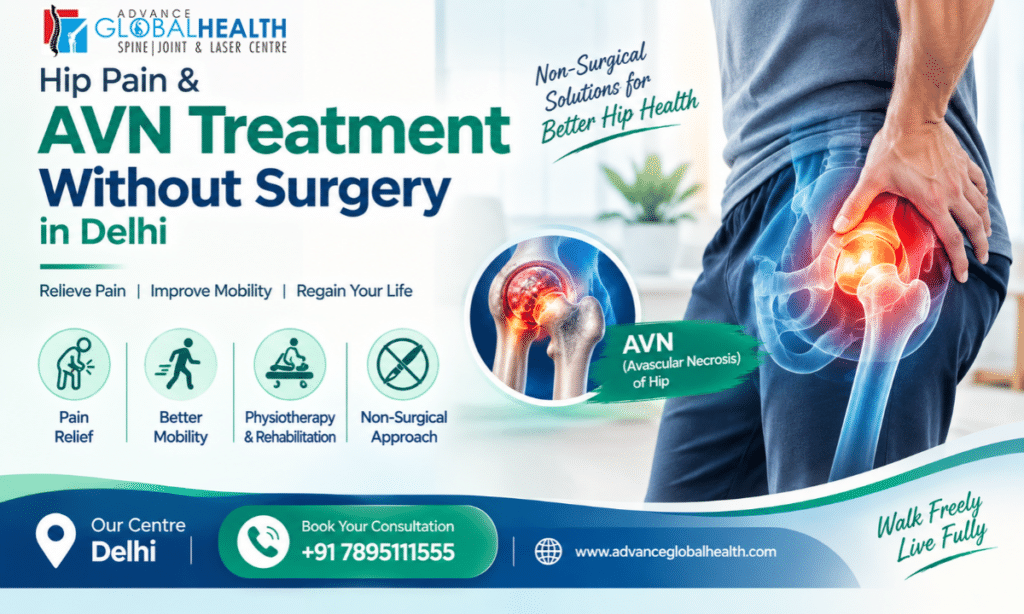
Hip pain can significantly affect walking, climbing stairs, sitting, exercising, and everyday activities. While hip pain may result from arthritis, muscle strain, injury, or other conditions, persistent pain can sometimes be associated with Avascular Necrosis (AVN) of the hip.
Avascular Necrosis, also called osteonecrosis of the femoral head, occurs when the blood supply to part of the bone is reduced or interrupted. Over time, the affected bone can weaken and, in advanced cases, collapse. Early diagnosis is therefore important because treatment options depend strongly on the stage, size and location of the affected area, and whether the femoral head has collapsed.
For patients searching for AVN treatment, AVN treatment without surgery, or avascular necrosis treatment without surgery, it is important to understand that non-surgical management can be considered in selected cases, particularly before significant femoral-head collapse. However, it should not be presented as a guaranteed cure or as a way to reverse established collapse.
At Advance Global Health – Spine | Joint & Laser Centre, treatment planning begins with an assessment of the patient’s symptoms, imaging, stage of AVN, mobility, and overall condition.
People Also Like to read this: Laser Treatment for Knee Pain: A Non-Surgical Approach to Better Mobility
What Is Avascular Necrosis of the Hip?
Avascular Necrosis of the hip affects the femoral head, the rounded upper part of the thigh bone that forms the ball of the hip joint.
When blood flow to this area is compromised, bone tissue can become damaged. If the condition progresses, the structural strength of the femoral head may decrease, potentially resulting in a subchondral fracture and collapse.
Common risk factors can include:
- Long-term or high-dose corticosteroid use
- Excessive alcohol consumption
- Previous trauma or hip injury
- Certain blood disorders
- Autoimmune diseases
- Some medical treatments and conditions
- In some patients, no specific cause is identified
Not every person with hip pain has AVN. Proper clinical assessment and appropriate imaging are necessary to determine the cause.
Symptoms of Hip AVN
Symptoms can develop gradually and may initially be mild. Common symptoms include:
- Hip or groin pain
- Pain while walking or standing
- Pain during weight-bearing activities
- Hip stiffness
- Reduced range of motion
- Difficulty climbing stairs
- Limping
- Increasing difficulty with everyday activities
Pain may initially occur during activity and may become more persistent as the condition progresses.
If hip or groin pain continues or worsens, an early evaluation can help determine whether the problem is AVN, arthritis, an injury, or another condition.
Can AVN Be Treated Without Surgery?
This is one of the most common questions after an AVN diagnosis.
The answer depends on several factors, including:
- Stage of AVN
- Size of the necrotic area
- Location of the lesion
- Whether the weight-bearing portion is involved
- Whether the femoral head has collapsed
- Severity of symptoms
- Age and activity level
- Overall health
Non-surgical management may be considered in selected patients, particularly those with early or pre-collapse disease. However, evidence indicates that conservative treatment alone may not stop progression in many patients.
The goal of AVN treatment without surgery may therefore include managing pain, reducing mechanical stress on the hip, maintaining mobility and function, and potentially delaying more invasive treatment when clinically appropriate.
Importance of Early Diagnosis
Early diagnosis is particularly important in AVN because treatment possibilities can change as structural damage progresses.
X-rays may appear normal during very early disease, while MRI can detect AVN earlier and help determine the size and location of the lesion. Clinical guidance emphasizes accurate staging and assessment of the presence or absence of femoral-head collapse when selecting treatment.
At Advance Global Health, the assessment may include a review of imaging and symptoms along with evaluation of hip movement and functional limitations.
Non-Surgical Approaches for AVN Treatment
1. Protected Weight-Bearing
Reducing excessive loading on the affected hip can help manage symptoms.
Depending on the patient’s condition, a specialist may recommend modifying activities or temporarily using an appropriate walking aid. High-impact activities that place repeated stress on the hip may need to be reduced.
Protected weight-bearing is generally considered a component of comprehensive management rather than a standalone treatment capable of stopping AVN progression.
2. Physiotherapy and Rehabilitation
Rehabilitation can help maintain mobility and strengthen the muscles surrounding the hip.
A personalized program may focus on:
- Hip mobility
- Muscle strengthening
- Balance
- Walking patterns
- Functional movement
- Maintaining independence
- Low-impact activity
Advance Global Health’s AVN rehabilitation program describes mobility restoration, strengthening, manual therapy, weight-bearing strategies, and low-impact exercise as components of rehabilitation.
Exercises should be selected according to the patient’s condition and should not unnecessarily overload a damaged femoral head.
3. Activity Modification
Patients may need to modify activities that increase hip pain or place excessive impact on the joint.
Low-impact activities may be considered when appropriate, while high-impact sports, jumping, and activities that aggravate symptoms may need to be restricted.
4. Pain Management
Pain management can be an important part of avascular necrosis treatment without surgery.
Medication choices should be discussed with a qualified healthcare professional because the appropriate medicine depends on the patient’s medical history, other medications, kidney and stomach health, and other factors.
5. Selected Physical or Advanced Approaches
Various physical and biophysical approaches—including shockwave therapy, electromagnetic therapies, and hyperbaric oxygen—have been studied for AVN. However, evidence varies between treatments, and some guidelines have found insufficient evidence to recommend certain modalities for preventing progression.
Advance Global Health offers advanced non-surgical and rehabilitation approaches as part of its musculoskeletal care. Any technology-based treatment should be considered after individual assessment rather than assuming that one treatment is appropriate for every AVN patient.
What About Stage 3 and Stage 4 AVN?
Patients frequently search online for AVN treatment without surgery after being diagnosed with Stage 3 or Stage 4 disease.
These stages require particular caution.
Depending on the classification system, Stage 3 generally indicates structural damage or subchondral fracture/collapse. Stage 4 can involve more advanced collapse and secondary degenerative changes.
Clinical guidelines indicate that treatment selection should consider the extent of necrosis, collapse, symptoms, age, and hip function. In advanced disease with significant collapse and joint degeneration, surgical options—including hip replacement—may need to be considered.
Therefore, avascular necrosis treatment without surgery should not be advertised as a guaranteed alternative to hip replacement for advanced AVN.
Some patients may still require comprehensive non-surgical management for symptom control or while treatment options are being evaluated, but the appropriate approach must be individualized.
Can Non-Surgical AVN Treatment Delay Hip Replacement?
In selected patients, conservative management may help reduce symptoms and maintain function and may sometimes allow more time before surgery becomes necessary.
However, there is no guarantee that non-surgical treatment will prevent disease progression. Established femoral-head collapse cannot simply be reversed through physiotherapy or conservative care.
This is why accurate staging and regular clinical follow-up are important.
When Should You Consult an AVN Specialist?
You should consider an evaluation if you experience:
- Persistent hip or groin pain
- Increasing pain while walking
- Difficulty standing for long periods
- Hip stiffness
- Reduced hip movement
- Limping
- Difficulty climbing stairs
- A previous history of significant steroid use or other AVN risk factors
If AVN is suspected, timely imaging and specialist assessment can help determine the extent of the condition.
AVN Treatment at Advance Global Health in Delhi
Advance Global Health – Spine | Joint & Laser Centre provides assessment and non-surgical musculoskeletal care for patients experiencing hip pain and AVN.
The centre’s AVN rehabilitation information includes strengthening, mobility restoration, manual therapy, activity modification, weight-bearing strategies, and low-impact exercises.
Treatment is planned according to the patient’s condition rather than applying the same approach to every case.
Delhi Centre:
D-106, Near Gate No. 1, Block D, Panchsheel Enclave, New Delhi – 110017
Contact: +91 7895111555
Conclusion
AVN treatment without surgery may be an option for selected patients, particularly when AVN is identified before significant femoral-head collapse. Treatment may involve protected weight-bearing, activity modification, physiotherapy, rehabilitation, pain management, and selected advanced approaches depending on the patient’s individual condition.
However, avascular necrosis treatment without surgery is not a guaranteed cure, and advanced AVN with significant collapse may require surgical evaluation. Current evidence emphasizes accurate staging, imaging, lesion characteristics, and individualized treatment decisions.
If you are experiencing persistent hip pain or have already been diagnosed with AVN, an early specialist evaluation can help you understand the stage of the disease and the treatment options that may be appropriate for you.
